Happy Easter Oh No Funny T-rex: A Designer’s Review
As an embroidery product reviewer and designer, I approach every new graphic with a specific question: will this actually stitch out well on fabric? When evaluating the Happy Easter Oh No Funny T-rex, my first impression is that it strikes a difficult balance between humor and technical viability. The design captures a playful, chaotic energy that resonates immediately with parents and anyone who appreciates dinosaur-themed holiday apparel. Visually, the composition suggests a narrative moment—the T-rex’s panic is relatable and funny—but from a production standpoint, I am looking at line weights, text legibility, and how those vector elements will translate into thread.
This review focuses on practical application for machine embroidery design projects. Whether you are an Etsy seller planning a spring collection or a hobbyist making personalized gifts, understanding how this graphic behaves in real-world scenarios is essential before you commit thread to fabric.
Translating Vector Graphics to Stitch Reality
The Happy Easter Oh No Funny T-rex comes as a comprehensive digital asset package, including AI, EPS, and high-resolution PNG files. For apparel decorators and creative entrepreneurs, having editable source files is non-negotiable. However, possessing an EPS file does not automatically guarantee a successful embroidery project. These graphics serve as the blueprint, but the transition from screen to textile requires careful interpretation.
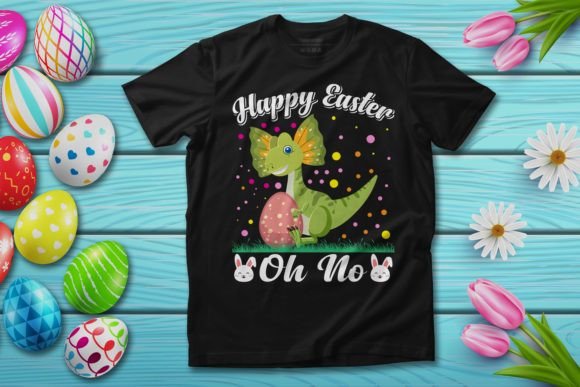
When I look at the bold lines of the T-rex and the accompanying "Oh No" typography, I see potential for both satin stitch outlines and fill stitch interiors. The humor relies heavily on the expression and the timing of the text. If the lettering is too thin or the facial details are lost during digitizing, the joke falls flat. Because this product includes 300 DPI transparent backgrounds and mockups, you can visualize the placement accurately. Yet, I always advise testing the design assets on scrap fabric first. Monitor how the stitch density interacts with your chosen material. A design that looks crisp on a high-quality JPG mockup might require density adjustments when stitched onto a textured sweatshirt or a stretchy t-shirt.
Real-World Application: The Toddler Sweatshirt Test
To truly evaluate this design, let’s consider a specific real-life scenario: creating custom apparel for a toddler’s Easter basket. This is a prime use case for T-Shirt Designs featuring humorous characters. Toddlers move constantly, their clothes get washed frequently, and the fit must remain comfortable against sensitive skin.
In this context, the Happy Easter Oh No Funny T-rex performs best when treated as a centerpiece rather than an all-over print. For a sweatshirt embroidery project, I would position the design slightly above center chest. The "Oh No" element adds a layer of personality that generic bunny designs lack, making it a standout handmade product for craft fairs or boutique listings. However, because toddlers are active, the embroidery must be soft. I recommend checking if the digitized version uses lightweight fill stitches rather than dense blocks. Heavy stitching on a small garment can create a stiff, bulletproof patch effect that ruins the drape of the fabric. Using the correct stabilizer is critical here to prevent puckering around the detailed edges of the dinosaur while maintaining the garment's flexibility.
Navigating Fabric Limitations and Hoop Sizes
Not every surface is friendly to detailed graphics. While the Happy Easter Oh No Funny T-rex is versatile, certain applications demand caution. Small hoop sizes often struggle with designs that combine intricate character details with text. If you are working with a 4x4 hoop, verify that the smallest text elements remain legible after resizing. Reducing complex graphics too aggressively can cause running stitches to merge or satin stitches to become unmanageable loops.
Fabric texture also dictates success. On smooth cotton or polyester blends, the design will shine. On highly textured fabrics like terry cloth towels or chunky knits, fine details may disappear. In these cases, you might need to add a topping stabilizer or simplify the design using the provided editable files. Dark fabrics present another challenge; ensure your thread colors offer sufficient contrast against the background. The included color-changeable feature is invaluable here, allowing you to adapt the palette for navy blue hoodies or pastel pink onesies without losing visual impact. Always compare light and dark fabric backgrounds in your printable mockup phase to anticipate contrast issues before production begins.
Commercial Viability for Makers and Sellers
For Etsy sellers and small shop owners, product value hinges on professionalism and uniqueness. The Happy Easter Oh No Funny T-rex offers strong commercial potential because it taps into a specific niche: anti-perfectionist holiday humor. Customers trust brands that understand their reality, and a panicked dinosaur holding an Easter egg speaks volumes to busy parents.
However, buyer engagement depends on presentation. Utilize the high-quality mockups provided to showcase the design on realistic garments rather than flat digital renders. Show the design on a tote bag design layout, a baby bib, or a casual tee. This helps customers envision the finished product in their own lives. Furthermore, confirm licensing terms explicitly. While the package notes editable and commercial-ready features, responsible business owners must verify whether they can sell the physical embroidered items versus the digital embroidery file itself. Protecting your brand consistency means ensuring you have the right to use the design in your specific business model, whether that involves selling custom apparel or offering personalized gift services.
Technical Checklist Before You Stitch
Before loading this design into your machine, run through this practical checklist to ensure professional results:
- Verify File Compatibility: Confirm that the AI or EPS files convert correctly in your specific embroidery software or digitizing program.
- Test Stitch Density: Run a sample on your target fabric to check for stiffness or thread breaks, especially in detailed areas.
- Check Text Legibility: Ensure the "Oh No" text meets minimum height requirements for your needle size and fabric type.
- Evaluate Stabilizer Pairing: Match cut-away or tear-away stabilizers to the stretch and weight of your base garment.
- Review Color Contrast: Use the transparent PNG to overlay thread colors against your actual fabric swatch.
- Inspect Small Details: Look for tiny jump stitches or gaps that might occur during the conversion from graphic to stitch file.
- Confirm Licensing: Double-check permissions for selling finished goods versus digital assets to avoid legal issues.
Final Thoughts on Design Utility
The Happy Easter Oh No Funny T-rex is more than just a seasonal novelty; it is a functional design asset for makers who understand their audience. Its strength lies in its emotional connection and adaptability across various products, from nursery decor to adult humor tees. By approaching this graphic with a technician’s eye and a crafter’s heart, you can transform digital pixels into tangible, high-value merchandise. Remember that successful embroidery is a marriage of art and engineering. Take the time to test, adjust, and validate your process, and this design will undoubtedly become a profitable and beloved addition to your holiday catalog.